Earrings
Cushion Cut Diamond Earrings
The cushion cut reads differently in earrings than it does in rings. Motion changes everything. What looks like warm, diffused brilliance on a stationary finger becomes active fire when the stone moves with you.
Set a cushion cut diamond on a table and it looks soft, romantic, a little antique. Put it in a stud earring and walk across a room, and it becomes something else entirely. The larger facets that give the cushion its characteristic warmth also catch and release light more dramatically as the stone tilts and shifts with the natural movement of the head. The fire that is only hinted at in stillness becomes the dominant quality in motion.
This is the fundamental reason the cushion cut earring is a different proposition than the cushion cut ring. The ring sits still. The earring rarely does.
Understanding the
Cushion Cut
The cushion cut is one of the older diamond shapes still in regular production. Its origins are in the old mine cut, the dominant shape from the 1700s through the early 1900s, which was designed to maximize brilliance under candlelight. The old mine cut had a smaller table, a larger culet (the flat facet at the base), and a higher crown than modern cuts. It was optimized for warm, flickering light rather than the flat overhead illumination of contemporary spaces.
The modern cushion cut retains the rounded corners and pillow-like outline of its ancestor but applies contemporary cutting standards to the facet arrangement. There are two main variants. The standard cushion modified brilliant adds extra facets beneath the girdle, producing more of a “crushed ice” look with smaller, more scattered light reflections. The chunky cushion, sometimes called cushion brilliant, keeps larger facets and produces broader, more defined light patterns similar to the old mine cut.
For earrings specifically, both styles work well, but the chunky cushion’s larger facets produce the more dramatic individual flashes of color and white light, particularly noticeable in motion.
Why Earrings
Change the Equation
In a ring, a cushion cut diamond is evaluated primarily in stillness. The client looks at it on the hand, lifts it to the light, rotates the finger. The fire is a pleasant accent to the stone’s overall character.
In an earring, the stone is almost never still. The natural movement of the head while speaking, turning, walking brings the facets in and out of alignment with light sources continuously. This means the fire, the spectral color dispersion that distinguishes the cushion from harder-edged shapes, is an ongoing presence rather than an occasional feature.
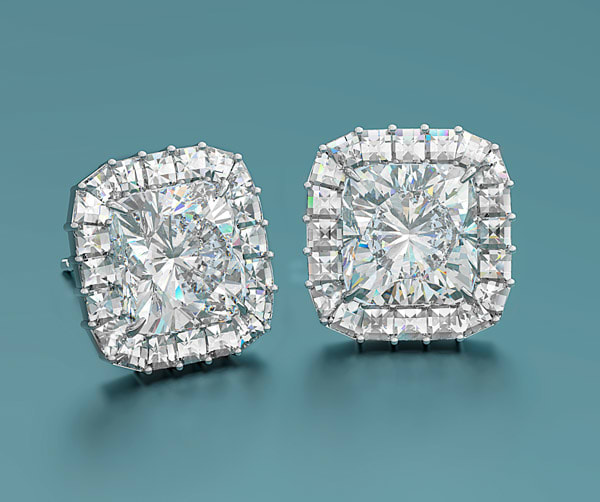
Bez Ambar’s Ring of Fire cushion cut earrings carry this idea as far as it goes. A pair of 2-carat E-SI cushion cut centers, each framed in a complete surround of Blaze® cut diamonds, the gap-free patented square accent stones. The frame closes completely, no interruption between stones, so the center and the surround move as a single field of light. Each earring reads closer to 6 carats face-up. The width across each stud is approximately 11.5mm, substantial presence without extreme weight.
Setting the
Cushion in an Earring
The setting requirements for an earring differ from a ring in one important respect: protection of the corners is less critical. A cushion cut ring is vulnerable at its rounded corners during the hand-forward activities of daily life. An earring sits away from contact with surfaces, which means the prongs can be fewer and lighter without meaningful risk to the stone.
A four-prong setting, one at each corner, is the standard for cushion studs. It lifts the stone from the ear and allows light to enter from below, which matters for a cut that depends on light coming from multiple angles. A bezel setting is a valid alternative for those who prefer a cleaner profile, though it reduces light entry from the sides.
For cushion cuts set inside a Blaze® frame, the setting becomes secondary to the frame itself. The frame holds the center and defines the overall silhouette. The combination of a cushion center inside an unbroken square of accent diamonds produces something architecturally distinct, geometric at the outer edge, soft at the center.
Explore the collection or contact us to discuss cushion cut options.
What People
Ask Us
What is the difference between old mine cut and modern cushion cut? The old mine cut, originating in the 1700s, had a smaller table facet, a higher crown, and a larger culet than today’s standards. It was optimized for candlelight. The modern cushion cut keeps the rounded outline and soft corners but applies current proportions for better performance under modern lighting. Both appear in estate and custom work; the choice is a matter of which light quality appeals to you.
Do cushion cuts look good as earrings? Cushion cuts are particularly well suited to earrings because motion activates their fire in a way that static viewing does not show. The broad facets and rounded outline produce warm, active light patterns as the earring moves with the wearer. They read well at conversational distance.
How does the Blaze® frame make a cushion stud look larger? The Blaze® frame is built from custom-cut square accent diamonds that sit edge to edge with no gaps. The continuous perimeter of light fuses visually with the center stone, so the eye cannot locate where the center stone ends and the frame begins. The result is a dramatic increase in perceived size: a 2-carat cushion in a Blaze® frame reads closer to 6 carats face-up.
What is the price range for cushion cut diamond studs? Significant cushion cut studs, 1.00 carat and above per stone, occupy a wide range depending on quality. At 2 carats per stone with an E-SI specification and a full Blaze® frame, the Bez Ambar Ring of Fire cushion earrings are priced at $42,000 for the pair including the diamonds. Contact us for current availability and to discuss stone specifications at other carat weights.
Can I request a specific cushion cut center stone for a pair of studs? Yes. We source cushion cut centers to specification. The key variables are carat weight per stone, color grade, clarity grade, and whether you prefer the standard modified brilliant (crushed ice) or the chunky cushion facet style. We can show options before committing to a setting.
Commission a Piece of Your Own
Every piece is designed and made in the Los Angeles atelier, from the first reading of the stone to the final pass of the setting wheel. Enquire to begin a commission.


