Earrings
Diamond Drop Earrings: Form, Weight, and Occasion
A diamond drop earring that photographs beautifully but pulls the lobe after twenty minutes is a design failure — the challenge is building something that moves, catches light, and disappears in terms of weight.
The Architecture of a Drop Earring
What Makes the Form Work
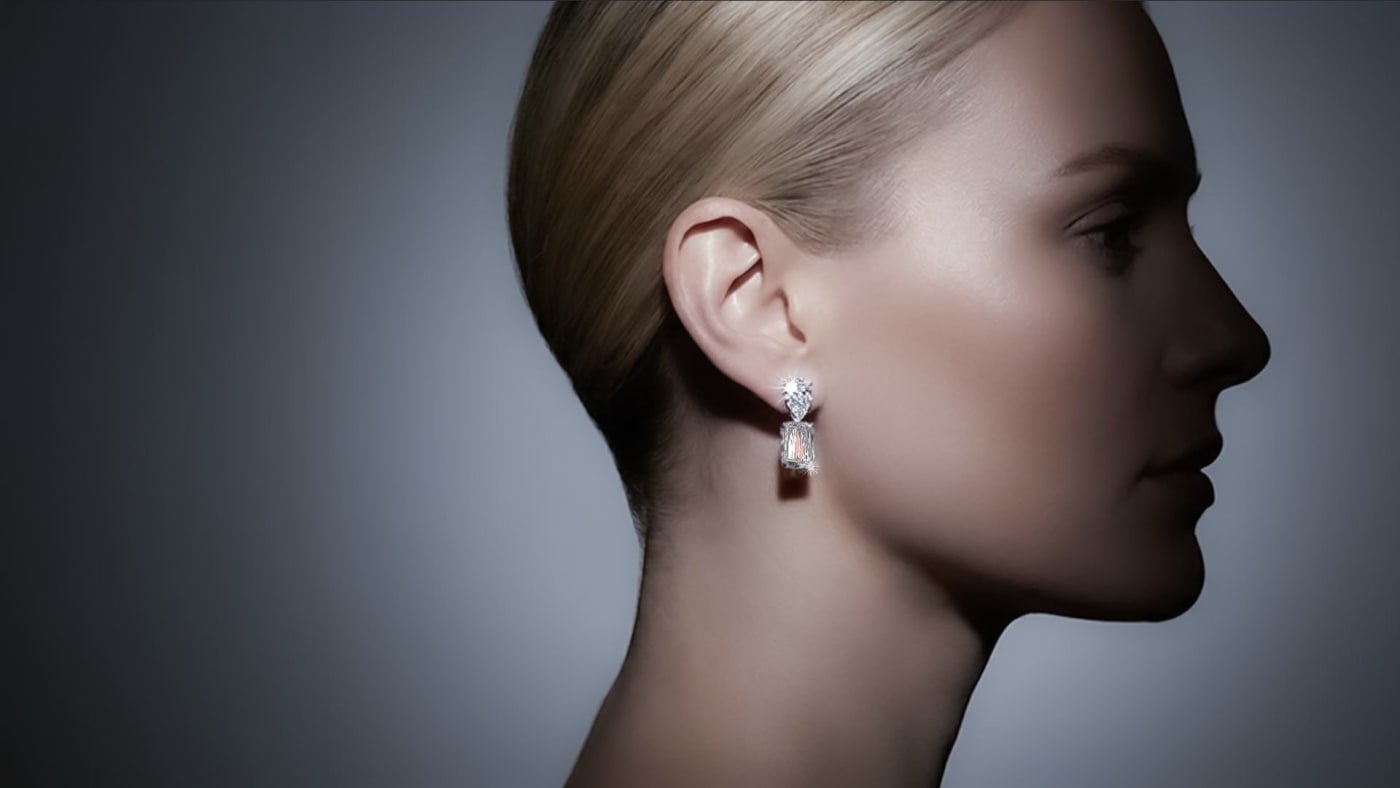
Drop earrings are defined by pendant elements that hang below the earlobe — distinct from studs, which sit at the earlobe, and hoops, which encircle it. The structural elements are the ear fitting (post and butterfly, or lever-back, or wire), the connector (which may be a short link, a diamond station, or a direct mounting), and the pendant element itself, which does the visual work. Each of these components affects weight, movement, and the way the earring presents against the neck.
The pendant’s proportional relationship to the fitting is what experienced designers think about first. A pendant that hangs too short is indistinguishable from a large stud at any social distance. A pendant that hangs too long creates structural challenges and may brush the shoulder with certain necklines. The functional sweet spot for most formal drop earrings is 25 to 45 millimeters of total length from the top of the fitting to the bottom of the pendant — long enough to show clearly, short enough to be wearable through a full event.
Diamond Selection for Drop Earrings
Stone Quality in a Motion Context
Drop earrings move. That motion is part of their value — catching light from shifting angles as the wearer turns her head. The implication for diamond selection is that brilliance and scintillation matter more than they do in a static setting. A well-cut round brilliant or modified brilliant shape will activate under movement in a way that a poorly cut stone or a shape with low performance will not.
Color and clarity standards in drop earrings can reasonably be set one to two grades below what you might choose for an engagement ring solitaire, because the stones are viewed at greater distance from the viewer’s eye, are typically smaller individually, and are in motion. A G-H color and VS2-SI1 clarity is a reasonable starting point for the stone quality in a fine diamond drop earring without paying the premium for D-E-F and VVS clarity that the viewing distance does not require.
Weight Distribution and Wearability
The Engineering Problem Every Pair Must Solve
Metal weight, stone weight, and the vertical distribution of that mass all determine whether the earring is comfortable. A bottom-heavy design with most of the weight concentrated at the end of a long pendant will pull and swing more than one where the weight is distributed along the length. Platinum and 18k gold have the same visual density but different physical weights, which is why earring frames are often made in 14k or 18k gold rather than platinum regardless of what metal the wearer prefers — the weight difference over an evening is meaningful.
The ear fitting itself contributes to comfort. Lever-back closures distribute the earring’s weight more evenly across the lobe than a standard butterfly back on a thin post. For heavier drop earrings, a lever-back or threaded screw back reduces the tendency for the earring to tilt or rotate outward over the course of an evening.
Occasion Calibration
From Formal Evening to Daytime Appropriate
The occasion governs the appropriate scale of a diamond drop earring. A chandelier earring with three inches of cascading diamond stations is appropriate for a black-tie event and conspicuous at a business lunch. The same design logic that makes it spectacular in one context makes it incongruous in another. Most clients who invest in fine drop earrings benefit from two designs that cover different registers — a modest, elegant shorter drop for versatile daytime and evening wear, and a more dramatic piece reserved for formal occasions.
The length of the earring relative to the wearer’s neckline and hairstyle also matters practically. Shorter hair and lower necklines allow longer drops to read clearly. High necklines and longer hair can obscure shorter pendants. These are fitting-room considerations that catalog images do not capture.
What People
Ask Us
What is the difference between a drop earring and a dangle earring? The distinction is one of proportion and movement. Drop earrings are typically shorter and more structured — hanging one to two centimeters below the lobe. Dangle earrings tend to be longer, more fluid, and more explicitly kinetic in their design. The line between the two categories is not sharp, and the terms are used interchangeably in commercial contexts. What matters is the specific proportional relationship to the wearer’s face and the occasion.
How many total carats should a fine diamond drop earring carry? The range for meaningful fine diamond drop earrings runs from approximately 0.75 total carats (for a modest, versatile design) to 5 or more total carats for a substantial formal piece. Most clients looking for a significant but not extreme drop earring end up in the 1.5 to 3.0 total carat range, which offers real visual presence without the weight that larger total weights introduce.
What setting style best showcases diamonds in a drop earring? Prong settings maximize light entry and exit, which is ideal for brilliance in motion. Pavé and micro-pavé settings create texture and surface sparkle but sacrifice some of the dramatic scintillation of individual stones. Bezel settings offer security and a clean, modern line but reduce the light performance compared to prong settings. The right choice depends on the design aesthetic — all are legitimate.
Are diamond drop earrings appropriate as a gift rather than a personal purchase? They are a meaningful gift, but length and scale calibration are personal enough that getting it wrong is easy. If giving as a gift, choosing a design at the more modest end of the length range reduces the risk of the earring being too dramatic for the recipient’s taste or lifestyle. Including a gift receipt or discussing the design with the recipient before purchase is worth the slight reduction in surprise.
What metal works best for diamond drop earrings? White metals — platinum and white gold — create the cleanest visual relationship with colorless diamonds, allowing the stones to read without interference from the metal color. Yellow gold creates a warmer contrast that some clients find more interesting and historically resonant. Rose gold is a warm, contemporary option. The metal choice is personal and should align with the wearer’s existing jewelry and preference, not default to a single correct answer.
Continue Reading
- The Complete Guide to Diamond Hoop Earrings
- Ear Climber Earrings: The Modern Earring That Travels Up the Ear
- Huggie Earrings: The Small Hoop Worth Taking Seriously
Explore the Bez Ambar earring collection.
Ready to start your own piece? Contact the studio for a private consultation.
Commission a Piece of Your Own
Every piece is designed and made in the Los Angeles atelier, from the first reading of the stone to the final pass of the setting wheel. Enquire to begin a commission.


