Colored Stones
Tanzanite Jewelry: The Single-Source Stone Worth Understanding
Tanzanite was found in 1967 and comes from a single mining district in northern Tanzania — that geological reality shapes everything about how it should be bought and valued.
What Tanzanite Is
The Mineral, the Color, and the Only Source
Tanzanite is the blue-to-violet variety of the mineral zoisite, found exclusively in the Merelani Hills of the Manyara Region in Tanzania. The deposit is located near the base of Mount Kilimanjaro, and there is no other commercial source anywhere in the world. That geographic exclusivity is not a marketing claim — it is a geological fact that has been confirmed repeatedly as prospectors have searched elsewhere without success.
The color phenomenon that makes tanzanite remarkable is trichroism: the stone shows different colors along different optical axes. When you rotate a tanzanite, you see blue, violet, and red-brown shifting in and out depending on angle and light source. The finished stone’s dominant color depends heavily on how the cutter orients the gem within the rough. Cutters who understand tanzanite orient stones to emphasize the blue-violet face-up, suppressing the less desirable brown axis. Cutters optimizing for weight at the expense of color produce stones that look muddy from the front. The difference is visible immediately.
Grading Color in Tanzanite
What Separates a Fine Stone from a Mediocre One
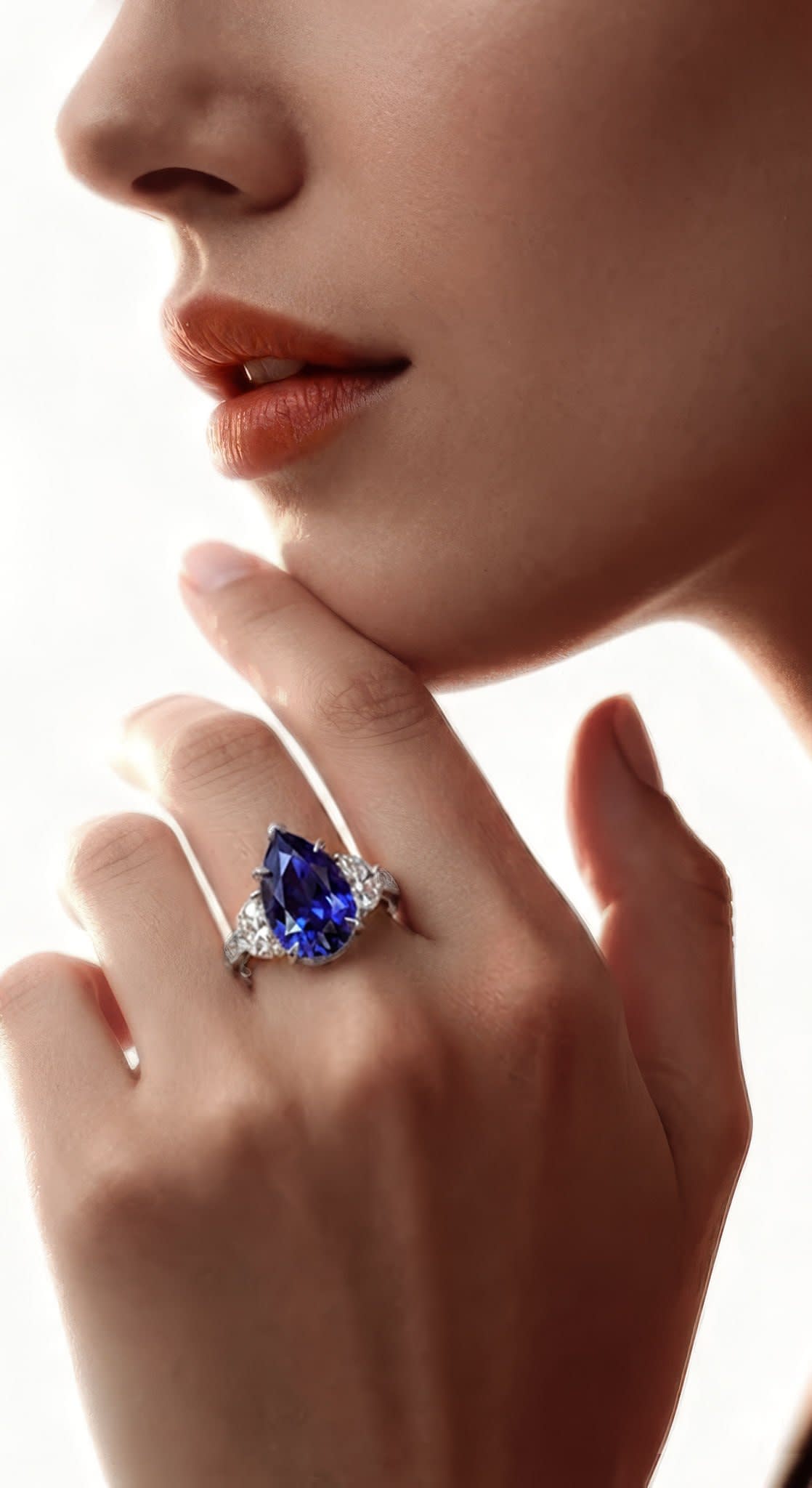
The finest tanzanite shows a deep, saturated blue-violet with a purple secondary hue that intensifies under incandescent light. The GIA color scale applies — hue, tone, and saturation are the three variables. Saturation is the most important. A deeply saturated tanzanite at medium-dark tone is the benchmark. Stones that are too light look washed out; stones that are too dark lose their characteristic violet shimmer and go inky. The window of optimal tone and saturation is narrower than buyers expect.
Heat treatment is universal in tanzanite. Raw tanzanite rough is typically brown-red. Heating to approximately 600 degrees Celsius drives off the brown component and reveals the blue-violet that makes the stone marketable. This treatment is permanent, stable, and fully accepted in the trade — there is no such thing as a commercially significant natural-color tanzanite in the blue-violet range. Disclosure is standard and expected, and “heat treated” on a tanzanite report means exactly the same thing as “cut” on a diamond report: it is part of what the stone is.
Durability Considerations
What Tanzanite Can and Cannot Do
Tanzanite scores 6 to 7 on the Mohs hardness scale, which places it below sapphire, ruby, and spinel. It also has perfect cleavage in one direction, meaning a sharp blow at the wrong angle can split a stone cleanly. For a pendant, earrings, or occasional-wear ring, tanzanite performs acceptably. For a daily-wear ring on a working hand, the risk of damage is real and worth discussing with your jeweler before committing to a center stone.
Setting matters enormously for tanzanite durability. A bezel or semi-bezel setting that protects the girdle is preferable to a high prong setting that leaves the stone exposed. If you want a tanzanite in a ring that will be worn every day, invest in a protective setting design. If you want maximum visual impact with less protection, reserve that ring for evenings and occasions.
Size and Value
How Carat Weight Affects the Tanzanite Price Curve
Tanzanite prices jump meaningfully at certain size thresholds. Below two carats, the market is broad and competitive. Between two and five carats, color quality starts to separate values more dramatically. Above five carats, genuine top color becomes rare enough that prices per carat increase sharply. The supply of large, well-cut, high-color tanzanites in the 10-to-20 carat range is constrained enough to support prices that surprised buyers who calculated value on a linear basis.
The Merelani mine has been in continuous operation, but geologists are not optimistic about the long-term supply trajectory. Whether that translates to continued price appreciation is impossible to predict, but the supply argument is not invented. The stone comes from one hillside, and that hillside is finite.
What People
Ask Us
Is tanzanite a good choice for an engagement ring? It depends on the lifestyle. Tanzanite in a protective bezel or cathedral setting, worn by someone who removes jewelry during manual work, is a reasonable choice that will last. Tanzanite worn continuously through cooking, gym use, and rough handling will show wear over years. Honest answer: sapphire is more durable for daily engagement rings, but tanzanite is appropriate for the right buyer in the right setting.
What does “AAA tanzanite” mean? It is a grade designation used by dealers and retailers — not a standardized laboratory grade from GIA or equivalent. Most dealers applying “AAA” mean deeply saturated, well-cut stones with excellent blue-violet color. The term is useful as shorthand but should not replace seeing the stone in person or getting a grading report on significant purchases.
Does tanzanite have investment value? The supply constraint argument is real, but tanzanite lacks the centuries-long collector infrastructure of ruby, sapphire, and emerald. It will not perform the way those stones do at auction. Think of it as a beautiful, relatively affordable, limited-source gemstone — not as a liquid investment. Buy it because you love it.
Why do some tanzanites look blue and others look purple? Both are tanzanite — the visible color depends on the tone, saturation, and how the cutter oriented the stone when fashioning it. Deeply saturated stones tend to read more blue face-up. Lighter stones reveal more violet and purple. Incandescent lighting brings out the purple-red axis; daylight emphasizes the blue. The stone genuinely changes character under different light, which is part of what makes it interesting.
What is the difference between tanzanite and blue sapphire at a glance? Tanzanite’s violet-blue is warmer and more intensely violet than the cornflower blue of fine Kashmir or Sri Lankan sapphire. Side by side, the difference is clear. Tanzanite also has lower refractive index, giving it slightly less brilliance than sapphire. Fine tanzanite and fine blue sapphire are not in competition — they are different gems with different visual personalities.
Continue Reading
- Tourmaline Jewelry: The Most Diverse Gemstone in Fine Jewelry
- Alexandrite: The Gemstone That Changes Color Under Different Light
- Amethyst Jewelry: The Purple Stone That Has Always Had Presence
Explore the Bez Ambar colored stone collection.
Ready to start your own piece? Contact the studio for a private consultation.
Commission a Piece of Your Own
Every piece is designed and made in the Los Angeles atelier, from the first reading of the stone to the final pass of the setting wheel. Enquire to begin a commission.


